
Deposits · Withdrawals · Balance · Turnover
Calculate the real cost of a gambling session
The latest win and the displayed balance never tell the whole story. A useful account separates money paid in, money actually withdrawn, the remaining withdrawable balance and the total amount staked.
The latest win and the displayed balance never tell the whole story. A useful account separates money paid in, money actually withdrawn, the remaining withdrawable balance and the total amount staked.
Start with every money movement
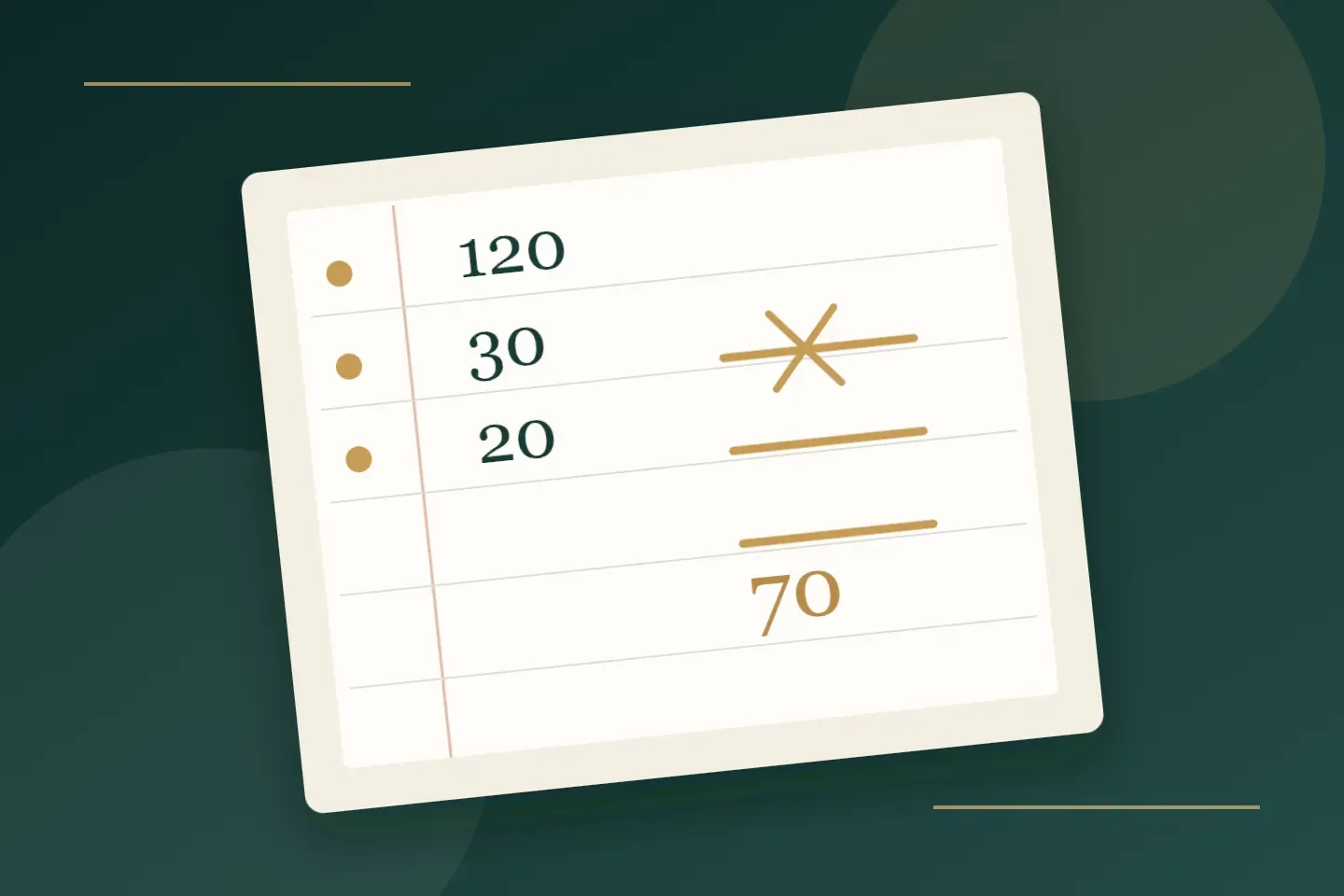
Add all deposits during the period, including repeated small payments. Subtract withdrawals already received and any remaining withdrawable balance. A positive result is a net loss; a negative result is a net gain.
Use a clear period, such as one month, across all accounts. A bonus that cannot yet be withdrawn is not money recovered. Record fees and pending transactions separately.
Separate net cost from betting turnover
The same money can be staked repeatedly after a small win. Turnover adds every stake, even when it comes from an existing balance. It can be much larger than deposits without any new money entering the account.
A small stake therefore does not guarantee a cheap session. A stake of €2 repeated 150 times creates €300 of turnover. The speed of play matters as much as the stake on each decision.
Do not treat theoretical loss as a forecast
At a theoretical operator edge of 4%, €300 of turnover implies a simplified average loss of €12. An individual session can lose much more, win or finish near even: short-term variation is substantial.
A return-to-player figure, odds or published average sets neither a loss ceiling nor a target to recover. The only money certainly protected is money you decide not to stake.
Turn the calculation into a firm limit
Keep essential expenses separate from leisure money. Set a loss limit and an end time before play starts, and regard the allocated money as spent. If it is not genuinely affordable to lose, do not gamble.
If deposits multiply or you start chasing losses, stop and review the full transaction history later. Self-exclusion and specialist support can help when limits no longer hold.
Worked example
Example: three figures with different meanings
Over one period: €120 deposited, €30 withdrawn and €20 still withdrawable. A €2 stake was placed 150 times.
| Measure | Calculation | Meaning |
|---|---|---|
| Net loss | 120 − 30 − 20 = €70 | Money lost at this point in time. |
| Turnover | 2 × 150 = €300 | All successive stakes, including recycled funds. |
| Theoretical loss at 4% | 300 × 0.04 = €12 | Model average, never a guaranteed outcome. |
Review the figures before continuing
Use the calculators for your own numbers. If gambling affects essential money or becomes hard to stop, consult the support resources.